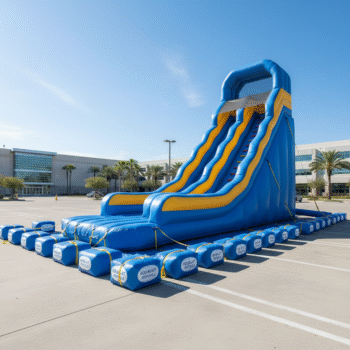


The Challenge of Hard Surface Setups
For inflatable rental companies and event organizers, securing structures on grass is straightforward: you drive heavy-duty stakes into the ground at a 45-degree angle. However, the industry reality is that many high-revenue events occur on surfaces where staking is impossible—parking lots, indoor gymnasiums, convention centers, and concrete plazas.
Anchoring inflatables on concrete or asphalt requires a different approach to safety. Without the mechanical hold of a ground stake, operators must rely on dead weight ballast to counteract wind uplift and lateral drag. This guide explores the technical and operational differences between the two primary ballast solutions—sandbags and water weight bags—and provides procurement advice for B2B buyers looking to upgrade their safety equipment.
The Physics of Non-Staked Anchoring
When an inflatable is staked into soil, the withdrawal force required to pull the stake out is significant. On a hard surface, you are relying solely on gravity (weight) and friction. Because the friction coefficient between a vinyl inflatable and smooth concrete is relatively low, the total weight required for a hard-surface setup is often significantly higher than the theoretical holding power of stakes.
Key Safety Rule: Never assume a single sandbag equals one stake. Engineering standards (such as ASTM or EN14960) generally dictate specific weight loads per anchor point based on wind calculations. Operators must consult the inflatable’s operation manual for specific ballast weight requirements.
Comparing Ballast Options: Sandbags vs. Water Weights
While concrete blocks are sometimes used for massive semi-permanent installations, the daily rental industry typically chooses between sandbags and water weights. Each has distinct implications for logistics and labor.
1. Sandbags
Sandbags are the traditional method for weighting down inflatables. They are typically made from heavy-duty vinyl (PVC) to match the inflatable and prevent leakage.
- Pros: Density is high (sand is heavy for its volume); they are mechanically simple; they do not puncture easily.
- Cons:
- Logistics: They are heavy to transport. A delivery truck must carry hundreds of pounds of useless dead weight to and from the event, increasing fuel consumption and vehicle wear.
- Labor: Crew members must lift and carry heavy bags repeatedly, increasing fatigue and injury risk.
- Mess: If a bag splits, sand creates a slip hazard on smooth floors and is difficult to clean up.
2. Water Weight Bags
Water weights have become the preferred standard for professional rental fleets, particularly for mobile operations.
- Pros:
- Transport Efficiency: Water bags are transported empty and flat. You only carry the weight of the PVC shell. They are filled on-site using a standard hose.
- Storage: When not in use, they fold down to a fraction of the space of filled sandbags.
- Professional Appearance: High-quality heat-welded PVC water bags look cleaner and more integrated with the inflatable unit than improvised weights.
- Cons: Requires access to a water source on-site. If the venue has no water spigot, this solution is not viable.
Technical Specifications for Professional Water Weights
Not all water bags are suitable for industrial use. When sourcing water weights for commercial inflatables, buyers should look for specific manufacturing details that ensure durability under pressure.
Material Composition
Commercial water weights should be manufactured from 0.6mm to 0.9mm PVC Tarpaulin. This is the same durable, multi-layer material used to build commercial bounce houses. Avoid thin consumer-grade plastics, which will burst under the pressure of the water or upon impact with the ground.
Welding Technology
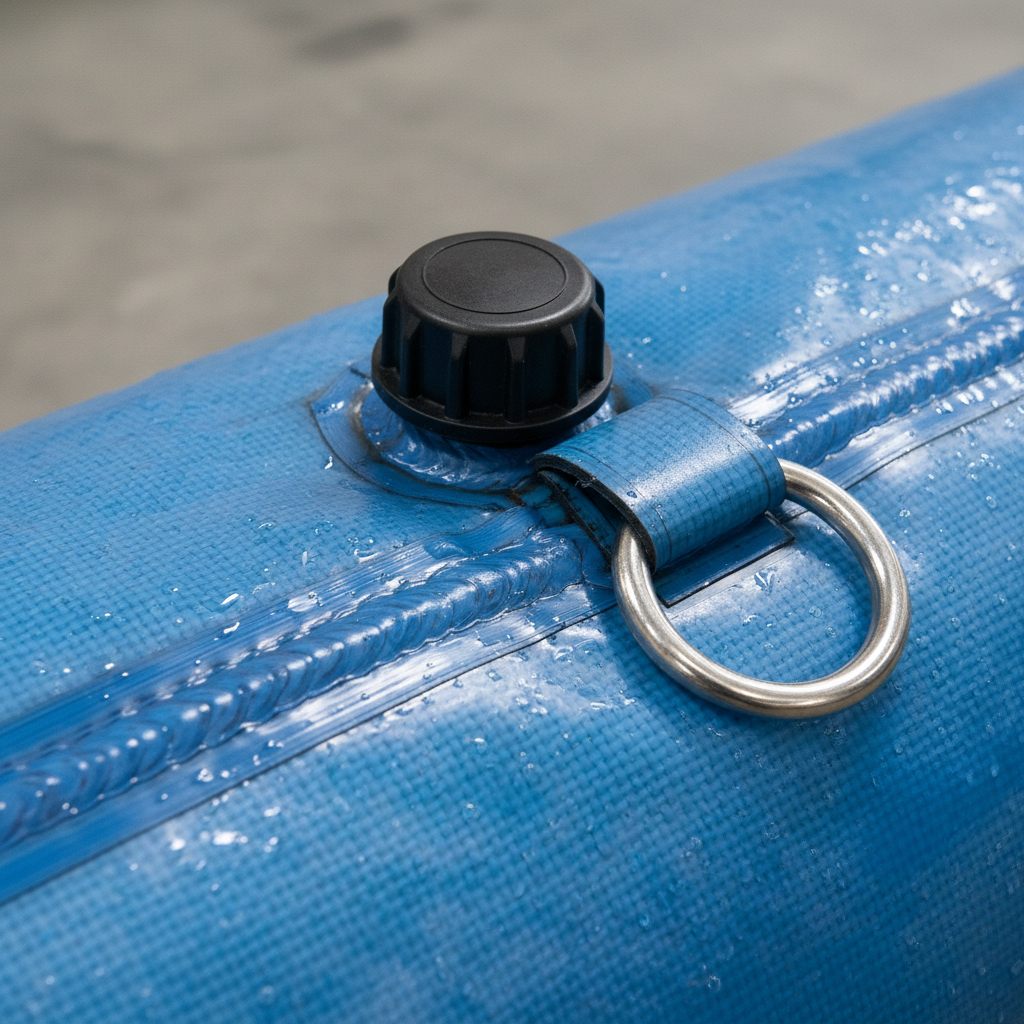
The seams must be high-frequency (HF) heat welded, not glued or sewn. Sewing creates needle holes that will leak water, and glue degrades over time with exposure to water and UV light. HF welding fuses the PVC layers into a single piece of material, ensuring a watertight seal that can withstand the internal pressure of the water.
Valve Systems
Look for high-quality air/water valves similar to those used on inflatable boats (e.g., Bravo valves). These allow for rapid filling and draining and include a secure cap to prevent accidental opening. A wide-mouth valve is preferable for faster drainage at the end of an event.
Attachment Points
The anchor point is the critical link. Ensure the bag features heavy-duty stainless steel D-rings reinforced with multi-layer webbing patches. The D-ring must be capable of withstanding the tension from the tie-down strap without tearing away from the bag.
Buying Guide: Sourcing for Rental Fleets
When procuring anchoring solutions from manufacturers, consider the following factors to optimize your investment.
Customization and Branding
Unlike sandbags purchased from a hardware store, ordering direct from an inflatable manufacturer allows for branding. You can request water weights in your company colors or have your logo printed directly on the PVC. This turns a safety necessity into a branding touchpoint at your events.
MOQ and Sampling
For B2B buyers, purchasing water weights in bulk (e.g., 50–100 units) often secures a better price per unit. However, requesting a sample is wise to test the valve quality and seam strength before committing to a fleet-wide purchase.
Capacity Options
Water weights typically come in various sizes, often measured by the weight of water they hold (e.g., 50kg, 100kg, 250kg). It is often more practical to use multiple smaller bags (e.g., two 50kg bags) per anchor point rather than one massive bag, as smaller bags are easier for crew members to position and drain.
الأسئلة الشائعة
How much weight do I need per anchor point?
There is no single answer; it depends on the size of the inflatable, the wind speed, and the manufacturer’s design. However, a common rule of thumb in the industry suggests a minimum of 160kg (approx. 350 lbs) per anchor point for large slides on hard surfaces, but you must verify this with your specific unit’s engineering report.
Can I use water weights indoors?
Yes, water weights are excellent for indoor use because they are clean and soft (no sharp edges to scratch gym floors). However, ensure you have a plan for draining them safely without flooding the venue (e.g., using a pump to run water to a drain).
Do water weights leak?
High-quality, heat-welded PVC bags are extremely reliable. Leaks usually only occur if the bag is punctured by a sharp object or if the valve is not tightened correctly. Always inspect bags before filling.
الخاتمة
Transitioning to professional water weight bags can streamline logistics and improve the professional appearance of your setup. By choosing high-frequency welded PVC options, you ensure that your anchoring system is as durable as the inflatables they secure.
Ready to upgrade your anchoring equipment? Contact us today to discuss bulk pricing on professional PVC water weights and custom-branded sandbag covers tailored for your rental fleet.

 Arabic
  English
  Spanish
  French
  Portuguese
  Japanese
  Italian