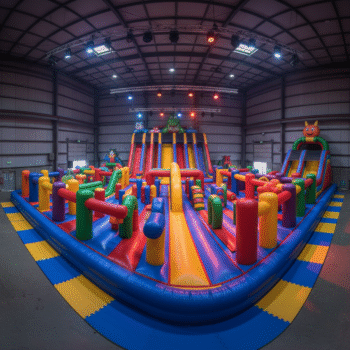


The transition from operating a mobile rental business to managing a permanent indoor inflatable park represents a significant shift in the family entertainment center (FEC) industry. While outdoor rentals rely on seasonality and weather conditions, a permanent indoor facility offers year-round revenue potential and higher customer retention.
However, launching a fixed-location indoor inflatable park requires a different approach to procurement, design, and facility management than purchasing standalone bounce houses for weekend events. For investors and business owners, understanding the technical nuances of indoor facility planning—from ceiling clearance to high-traffic material specifications—is critical to long-term success.
1. Assessing Venue Suitability and Dimensions

Unlike outdoor setups where vertical space is rarely an issue, indoor facilities operate within strict architectural limits. Selecting the right venue is the first and most critical step before commissioning a custom inflatable design.
Ceiling Height Requirements
The clear height of your building dictates the attractions you can offer. Standard commercial bounce houses may fit under 4-meter ceilings, but high-thrill attractions like giant slides or climbing walls often require 6 to 8 meters of clearance.
- Low Ceilings (<4m): Best suited for toddler zones, horizontal obstacle courses, and interactive games.
- High Ceilings (>6m): Essential for “wow” factors like mega slides and drop jumps that drive marketing appeal.
Note: Always account for the height of the inflation blowers if top-mounted, and leave at least 0.5–1 meter of clearance between the top of the inflatable and lighting fixtures or fire sprinklers to comply with safety regulations.
Floor Planning and Traffic Flow
An indoor inflatable park is not just a single unit; it is often a connected ecosystem of attractions. The floor plan must account for:
- Safety Zones: Impact mats must surround all entry and exit points.
- Egress Paths: Clear pathways for emergency exits are mandatory.
- Support Infrastructure: Space for blowers, electrical runs, and maintenance access.
2. Material Specifications for High-Traffic Use
In a rental model, a unit might be used for 6–8 hours once a week. In a permanent indoor center, the equipment faces continuous friction and stress for 8–12 hours daily, seven days a week. Standard recreational materials will degrade rapidly under this load.
Heavy-Duty PVC Tarpaulin
For permanent installations, we recommend exclusively using high-grade 0.55mm (18oz) PVC tarpaulin. This material offers superior resistance to tearing, abrasion, and UV damage (even indoors, UV-resistant coatings help maintain color vibrancy under artificial lighting).
Reinforcement Areas
When reviewing design specifications with your manufacturer, verify that high-stress areas include additional reinforcement:
- خياطة مزدوجة ورباعية: Essential at mattress seams and stress points (e.g., the base of climbing walls).
- Wear Strips: Replaceable layers of PVC on slide lanes and high-friction climbing surfaces allow you to repair wear and tear without replacing the entire unit.
3. Indoor-Specific Operational Challenges
Moving indoors introduces environmental controls that do not exist outdoors. Managing noise and heat is vital for customer comfort and equipment longevity.
Blower Placement and Noise Control
A park requiring 20+ blowers generates significant noise. In an enclosed warehouse, this can become overwhelming.
Solutions include:
- Sound-Dampening Boxes: Enclosing blowers in ventilated, sound-proof boxes.
- Remote Blower Rooms: Piping air through PVC ducts from a separate utility room to the inflatable, keeping the noise away from the play area.
HVAC and Heat Management
Blowers generate heat, and physical activity generates body heat. Your HVAC system must be sized not just for the square footage, but for the additional heat load produced by the mechanical equipment and active crowds.
4. Customization and Zoning
A successful indoor park caters to multiple demographics simultaneously. Custom manufacturing allows you to segment the park into distinct zones within a single cohesive structure.
The Toddler Zone
Separated from the main arena to prevent collisions with older children. Features usually include soft foam obstacles, smaller slides, and interactive ball pits. Visibility for parents is a key design requirement here.
The Challenge Zone
Targeting teenagers and adults, this area often features “Wipeout” style mechanical sweepers, extreme obstacle courses, and timed runs. These areas require deeper anchoring systems and higher-density foam padding.
5. Manufacturing and Safety Compliance
Safety standards for indoor parks are rigorous. Ensure your manufacturer adheres to international standards such as EN14960 (Europe) or ASTM (North America).
Anchoring Systems
Unlike outdoor setups that use ground stakes, indoor parks on concrete floors rely on different anchoring methods:
- Floor Anchors: Bolts drilled into the concrete (requires landlord permission).
- Ballast Systems: Heavy sandbags or water weights integrated into the design or concealed behind wall panels.
Fire Retardancy
Indoor fire codes are strict. The PVC material must be certified flame retardant. Always request current material test reports from your supplier to present to your local fire marshal during the permitting process.
6. Buying Guide: From Concept to Installation
Procuring a custom indoor park is a consultative process. Here is what to expect regarding timelines and logistics.
| Stage | Typical Timeline | Buyer Action Required |
|---|---|---|
| Design & Layout | 1–2 Weeks | Provide CAD floor plans, ceiling height, and pillar locations. |
| Production | 3–5 Weeks | Approve 3D renderings and color schemes. |
| الشحن | 4–6 Weeks | Arrange logistics for container delivery (20ft or 40ft HQ). |
| Installation | 1–2 Weeks | Coordinate local labor or request manufacturer installation support. |
Minimum Order Quantity (MOQ)
For custom indoor parks, the MOQ is typically one complete project. However, spare parts and maintenance kits (patches, glue, extra wear strips) should be included in your initial order to minimize downtime later.
Frequently Asked Questions (FAQs)
How much space do I need for an indoor inflatable park?
While small parks can fit in 300 square meters, a competitive FEC typically requires 800 to 2,000 square meters to accommodate varied attractions, party rooms, and amenities.
Can I customize the theme to match my brand?
Yes. Manufacturers can use digital printing to apply logos, mascots, and specific color palettes directly onto the PVC material. Ensure you provide high-resolution vector files for the best results.
How long does an indoor inflatable park last?
With proper maintenance and daily cleaning, a high-quality 0.55mm PVC park can last 3–5 years in a commercial setting before requiring significant refurbishment.
Do I need a specialized installation team?
Small units are plug-and-play, but a large connected park requires professional installation to ensure proper anchoring, connection of modular sections, and electrical safety.
Start Your Indoor Park Project
Launching an indoor inflatable center is a significant investment that requires precise planning and durable manufacturing. At Chinee Inflatable, we specialize in designing and manufacturing commercial-grade inflatable parks tailored to your facility’s dimensions.
Ready to discuss your floor plan? Contact us today to request a quote or get a free 3D design consultation.

 Arabic
  English
  Spanish
  French
  Portuguese
  Japanese
  Italian