

Effective Noise Control Without the Logistical Headache
Managing noise pollution is a critical operational requirement for modern construction sites and large-scale events. Whether complying with municipal decibel limits or creating distinct acoustic zones at a trade show, the challenge remains the same: how to block sound effectively without incurring massive transport and labor costs.
Traditional rigid noise barriers—often made of plywood, acrylic, or heavy composite panels—are effective but cumbersome. They require significant storage space, heavy transport vehicles, and extended setup times. Inflatable noise barriers offer a high-performance alternative, leveraging air-filled structural technology to dampen sound while offering unmatched portability. For procurement managers and site engineers, understanding the utility of these barriers can lead to significant cost savings and operational agility.
How Inflatable Sound Barriers Work
It is a common misconception that inflatable structures are too lightweight to block sound. However, the acoustic dampening properties of inflatable barriers rely on specific physical principles that differ from solid mass barriers.
- Air Gap Insulation: The core of the barrier is a large volume of air. Sound waves lose energy as they transition from the exterior air, through the heavy-duty PVC membrane, into the internal air chamber, and out the other side. This multi-layered transition disrupts the sound wave transmission.
- Membrane Flexibility: Unlike rigid walls that can vibrate and transmit resonance, the flexible outer skin of an inflatable barrier absorbs acoustic energy, reducing reflection and transmission.
- Structural Geometry: Inflatable barriers are often designed with curved or baffled surfaces. These shapes scatter sound waves rather than reflecting them directly back at the source, further reducing perceived noise levels.
Key Advantages for Construction and Industrial Sites
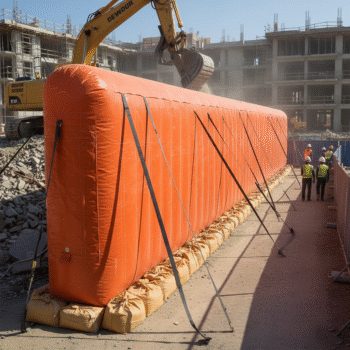
Construction projects in urban environments face strict regulations regarding noise pollution. Exceeding decibel limits can result in fines or work stoppages. Inflatable noise barriers provide a rapid-response solution.
1. Rapid Deployment and Demobilization
Time is money on a job site. A rigid barrier system might take a full day and a crane to install. In contrast, an inflatable barrier system can be deployed by a small crew in under an hour using standard air blowers. Once the project phase is complete, the barriers deflate and roll up, clearing the site immediately.
2. Reduced Logistics Costs
The volume reduction of an inflatable barrier from use-state to storage-state is drastic. A wall that spans 20 meters when inflated may fit onto a single pallet when deflated. This reduces the number of trucks required for transport, lowering fuel costs and carbon footprint—a growing priority for sustainable construction practices.
3. Dual-Purpose Safety and Dust Control
Beyond noise, these barriers act as effective visual screens and dust containment walls. Their soft structure is also inherently safer in high-traffic zones; accidental impact with an inflatable wall poses significantly less risk to workers and equipment than impact with a concrete or steel barrier.
Applications in Events and Exhibitions
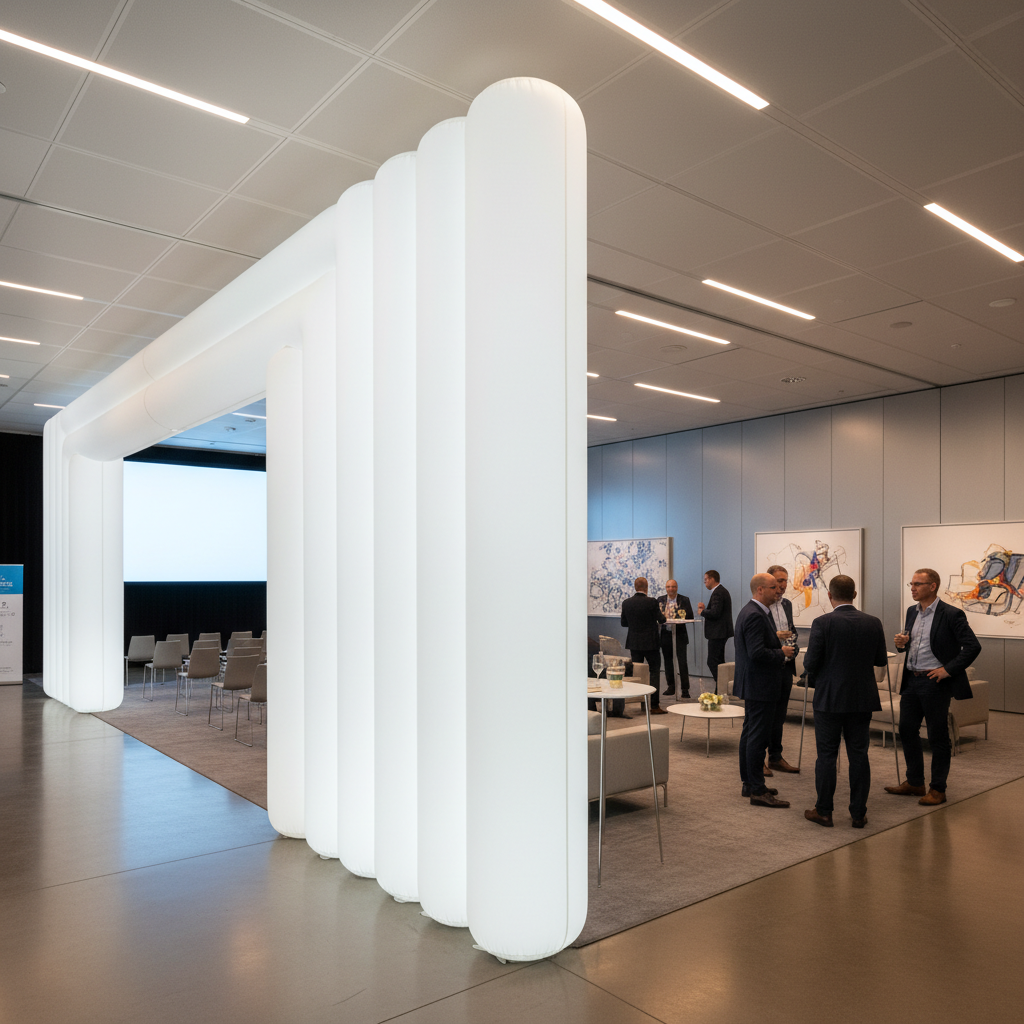
For event organizers, the priority shifts from regulatory compliance to attendee experience. Inflatable partitions allow for the creation of “quiet zones” within loud environments.
- VIP Zones and Meeting Areas: In busy trade shows, inflatable walls can quickly cordon off a private area for negotiations, dampening the ambient roar of the exhibition hall.
- Stage Separation: At festivals with multiple stages, large inflatable barriers can be positioned to minimize sound bleed between performance areas.
- Branding Opportunities: Unlike rented fencing, custom inflatable barriers can be manufactured with full-color digital printing. This turns a functional piece of infrastructure into a high-visibility billboard for sponsors or event branding.
Technical Specifications and Material Options
When sourcing inflatable noise barriers, it is essential to define the correct specifications for your environment.
Material Selection
Durability is paramount. For industrial use, we recommend Commercial Grade PVC Tarpaulin (typically 0.6mm to 0.9mm thickness). This material is:
- مقاومة للأشعة فوق البنفسجية: Prevents degradation during long-term outdoor exposure.
- Fire Retardant: Essential for compliance with safety codes at events and work sites.
- Abrasion Resistant: Withstands the rough handling typical of construction environments.
For indoor events where weight is a primary concern, lighter Oxford cloth with a PVC coating may be sufficient, though it offers less acoustic mass than heavy-duty tarpaulin.
Inflation Systems
There are two primary inflation types to consider:
- Constant Air (Sewn): Requires a continuously running blower. This is standard for very large structures but requires a constant power source. The noise of the blower itself must be managed.
- Sealed Air (Welded): These units are inflated once and sealed tight, similar to a rigid inflatable boat. They require no continuous power and are silent once set up, making them ideal for noise-sensitive applications.
Buying Guide: Customization and Manufacturing
Chinee Inflatable specializes in custom manufacturing to meet specific site requirements. When requesting a quote, consider the following factors to ensure accuracy.
Modularity and Connection
Do you need a single standalone wall or a modular system? Modular barriers can be designed with Velcro or zipper connections, allowing you to chain multiple units together to form a continuous wall of any length. Corner units can also be fabricated to create enclosed spaces.
Anchoring Systems
Inflatables are susceptible to wind. Professional barriers must include robust anchoring points. Ensure your design includes D-rings for stakes (for soft ground) and ballast bags (sand or water weights) for hard surfaces like concrete or indoor flooring.
Production Timelines and MOQ
Custom inflatable barriers are typically made to order.
- Design Phase: Allow 3-5 days for 3D rendering and approval.
- Production: Typical lead times range from 10-20 days depending on quantity and complexity.
- موك: While single units are often available, ordering in sets usually reduces the unit cost due to material cutting efficiencies.
الأسئلة الشائعة
How much noise can an inflatable barrier reduce?
While exact decibel reduction depends on frequency and environment, heavy-duty inflatable barriers typically offer a reduction of 10-20 dB. They are most effective at blocking line-of-sight high-frequency noise.
Are they puncture-resistant?
Yes, commercial PVC tarpaulin is designed to resist tears. However, sharp objects should be kept away. If a puncture occurs, it can usually be repaired easily on-site with a patch kit.
Can these barriers be used in the rain?
Yes, PVC materials are waterproof. However, if using constant-air blowers, the electrical components must be protected from water.
Do you offer custom printing?
Yes, digital printing is available to add logos, safety warnings, or decorative patterns directly onto the barrier surface.
الخاتمة
Inflatable noise barriers represent a smart convergence of logistics and acoustics. For temporary sites requiring flexibility, speed, and safety, they outperform traditional rigid walls. By choosing the right materials and anchoring systems, you can ensure a quieter, compliant, and more efficient workspace.
Ready to discuss your noise control needs? Contact us today to request a quote or design consultation for your custom inflatable barriers.

 Arabic
  English
  Spanish
  French
  Portuguese
  Japanese
  Italian